openvpn client can ping LAN but cannot TCP connect
-
I followed this guide: https://www.wundertech.net/how-to-set-up-openvpn-on-pfsense/
I have two clients that can connect via a mobile hotspot. Prior to connection they can't ping 192.168.6.anything (LAN subnet) or 10.0.8.1 (the openVPN subnet). I then connect and they can ping both, so the VPN part is working nicely.
I cannot make any TCP connections from an openVPN client to a LAN client. I've enabled the firewall rules to allow this in the wizard and they are shown in the firewall rule listing.
When I test a TCP connection and then look at the firewall logs I see errors like this one:
Default deny rule IPv4 (1000000103) 192.168.6.5:8123 10.0.8.2:48124 TCP:FA
I've tried the "automatic fix" recommended here: https://docs.netgate.com/pfsense/en/latest/troubleshooting/asymmetric-routing.html#automatic-fix it did not work
I've tried the manual fix on the allow all IPv4 rule on my LAN firewall interface where I allow all TCP states and "Sloppy", that didn't fix it.
I've tried having the openVPN be assigned the OPT2 interface, that didn't seem to resolve it. I did that like this https://docs.netgate.com/pfsense/en/latest/vpn/openvpn/assign.html#interface-assignment-and-configuration
Strangely I don't see the client listed in the openVPN connections list even though they ping other LAN IP addresses well....
What am I missing here?
-
@bmbouter said in openvpn client can ping LAN but cannot TCP connect:
What am I missing here?
There are thousands of web sites out there talking about 'how to'.
I advise you to start with the one made by the authors of pfSense.
You can find them here : https://www.youtube.com/@NetgateOfficialYou'll find also the Configuring OpenVPN Remote Access in pfSense Software
which explains how to set up, from a default pfSEnse, a working VPN access in less then 5 minutes.Again : can't tell if the video you used is good, or no good (I won't test them all ^^)
When you activate a VPN server, you wind up having a system created "OpenVPN" interface :
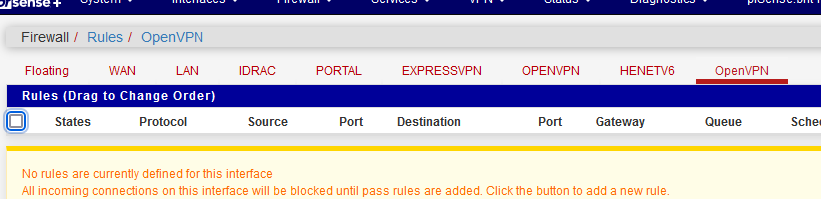
Leave that one empty.
Create your own OPENVPN (pick any name), and assign the openvpn server to it :

and then add the rules that will work fine :
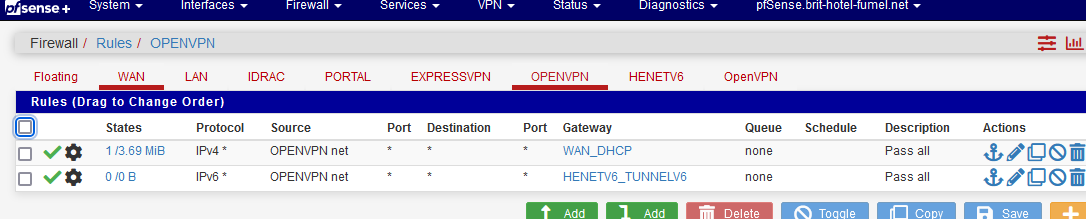
Note that I defined Gateways, that's normally not need - just create pass rules and you'll be fine.
Note that I used IPv4 and IPv6 as my OpenVPN server setup supports both, because ... why not.When I test my OpenVPN access, I can see that the states are changing == the rule is used.
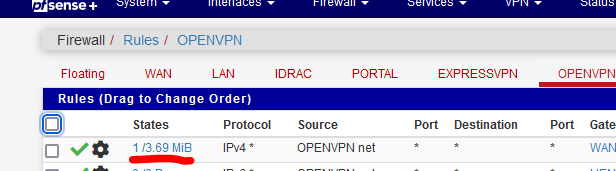
Btw : what is you pfSense version ?
Do you know what openvpn server version you use ? Hint : as always, check the openvpn server the logs ^^
Now, check you openvpn client software : it is based on what version ?For example, it's ok to use the 2.5.x version on the pfSense side, and a 2.4 (ancient) client openvpn on the other, but then you have to go through all the details of the release differences - seen here : https://openvpn.net/community-downloads/
-
I finally got a chance to test this. I totally remove the setup I had before, and I followed the video you linked to (thanks) exactly. However, I get the same result only now my openVPN subnet is 192.168.80.0/24.
The vpn itself is working fine. Any device I want can connect and get a 192.168.80.0/24 address. Any 192.168.80.0/24 IP can ping a 192.168.6.0/24 and vice versa, so the connectivity is there.
I'm using pfsense 22.05-RELEASE, openvpn server is OpenVPN 2.6_git armv7-portbld-freebsd12.3 (what came with my pfsense). I've used several clients for example latest openvpn android, and OpenVPN 2.5.8 on linux.
-
When I try to http connect for example between 192.168.80.2 (the vpn client) and a 192.168.6.0/24 address, I see these messages show up in the firewall around that time with the port numbers of the 192.168.6.0/24 I'm trying to tcp connect to:
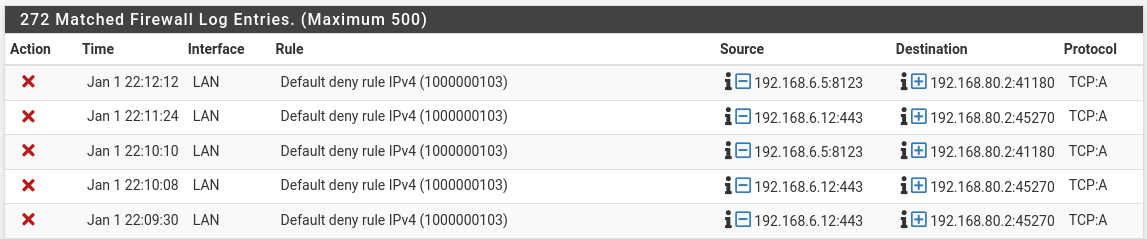
That is extremely strange because I have this in my LAN firewall:
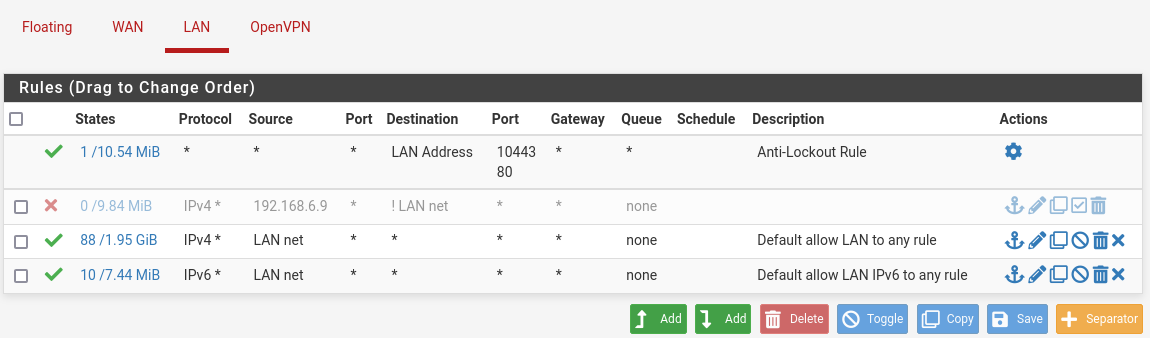
Why is the traffic being dropped?
-
@bmbouter said in openvpn client can ping LAN but cannot TCP connect:
Why is the traffic being dropped?
The traffic dropped on the LAN interface is traffic initiated by a LAN device, on the LAN network.
edit : but wait, see below.Your LAN interface is 192.168.6.1/24, right ?
The firewall rule show a connection from a LAN (source) 192.168.6.5 device port 443 ( ? ) to 192.168.80.2 device, the device you use to connect to the OpenVPN server.
Normally, it's the other way around.
I use my phone or portable PC to connect to the pfSense OpenVPN server, so I can connect to the pfSEnse GUI or my NAS, or printers to do some maintenance task.
You have your device connect, and the you initiate a connection he other way around ?And yes, I confirm, your LAN firewall rules permit any outgoing traffic.
The blocked TCP:A means to me : the TCP ACK packet send back doesn't make it back and is blocked, like it its not part of the a current state, initiated from an openvpn connect client (which would explained the reverse source destination).The state-full firewall isn't state-full anymore ?
What rules do you have to the OpenVPN network ?
Remember : the OpenVPN is like a LAN interface : it should have (TCP and UDP) pass rules, or no devices connected to it can use the OpenVPN interface == OpenVPN access.No "help me" PM's please. Use the forum, the community will thank you.
-
@gertjan There are several very strange aspects to this. Here is what I've observed.
The testing in this case is always initiated by the openVPN client. For example I would use an android device via LTE (openVPN connecting to the WAN IP) to receive the openvpn assigned IP of 192.168.80.2. Using an android network utility app, I can successfully ping various hosts on 192.168.6.0/24. I can also port scan 192.168.6.0/24 hosts and receive the expected results in every case. I can also run use telnet to TCP connect to an http webserver on 192.168.6.5 port 8123 and I receive response headers ... but I receive no body in the payload.....
When I use a web browser from 192.168.80.2 to connect to https://192.168.6.5 the page doesn't load and the firewall shows those dropped TCP:A packets. So the connection is initiated from the openVPN client, hence the destination port of 443.
Yes 192.168.6.1/24 is my LAN address.
My OpenVPN firewall rules were auto-created, but then I made it both IPv4 and IPv6 while troubleshooting it. Here's a screenshot.

It's like the statefulness of this firewall is totally screwed up. What's especially strange is I run pfsense on official netgate hardware, it's a SG-3100 MAX. I also only ever run the software provided by netgate.
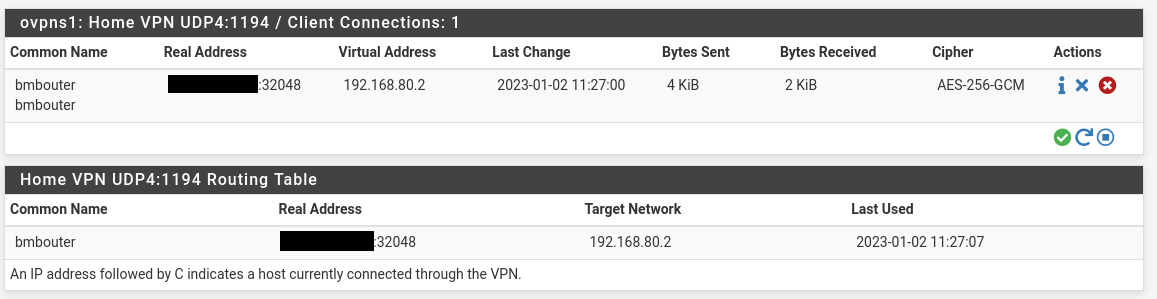
I can see my client listed in the openVPN connections, see this screenshot.
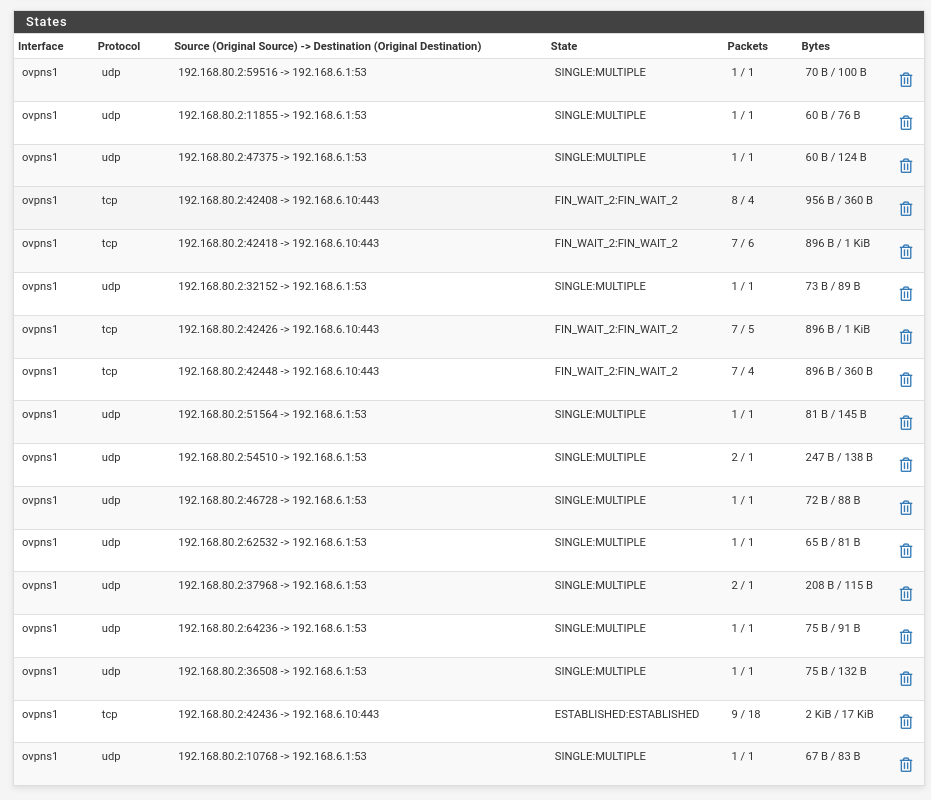
Also I can see some stateful connections being created in the openVPN firewall...
-
One more thing, I can confirm all the same behavior on my laptop acting as the 192.168.80.2 openvpn client. It's connecting via the WAN through a hotspot LTE connection.
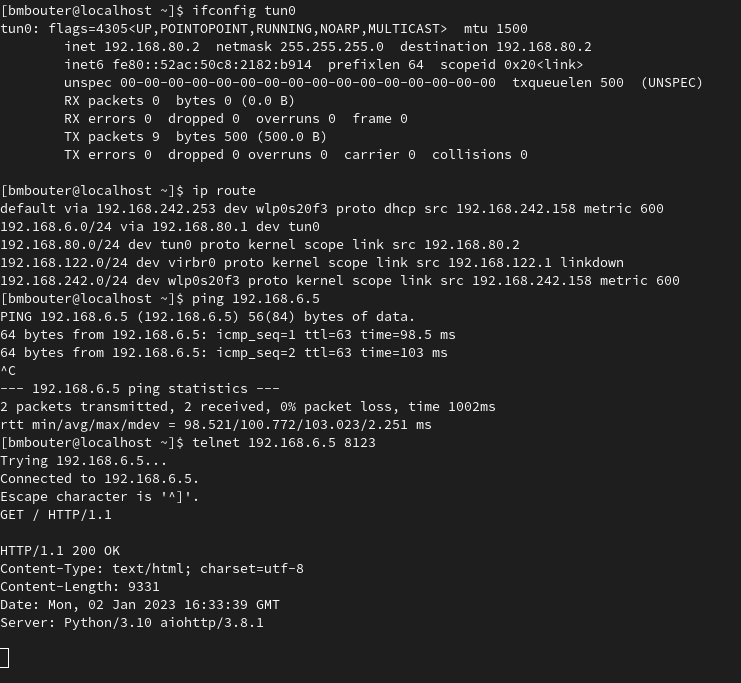
Here's a screen shot of some pings, ifconfig, ip route, and then the telnet demo
-
@gertjan said in openvpn client can ping LAN but cannot TCP connect:
The traffic dropped on the LAN interface is traffic initiated by a LAN device
no that is ack trafffic - looks like asymmetrical or the states were cleared on pfsense.
-
I think it's got to be some sort of asymmetric issue. What would I look at to investigate that?
I think it's not a pfsense firewall being cleared during testing because a) I'm not clearing it and I'm theonly admin and b) if I try the test a few hours later I get the same results. Just before retrying the test later I confirm the openVPN has no sessions on it. That being said maybe I should try clearing the sessions of both the LAN and WAN? I do have my clients when testing on my LAN just before disconnecting and joining the openVPN over the WAN.


Hello! It looks like you're interested in this conversation, but you don't have an account yet.
Getting fed up of having to scroll through the same posts each visit? When you register for an account, you'll always come back to exactly where you were before, and choose to be notified of new replies (either via email, or push notification). You'll also be able to save bookmarks and upvote posts to show your appreciation to other community members.
With your input, this post could be even better 💗
Register LoginPrivacy Policy · Cookie Policy