• 0 Votes
    4 Posts
    1k Views
    jpgpi250J
    @stanwij1 https://chatgpt.com/ what is suricata rule 2013075 Suricata rule 2013075 is a rule designed to detect network traffic associated with the C&C (Command and Control) communication of malware. Specifically, this rule is meant to detect possible communications from a malware sample to a command and control server using HTTP as the communication protocol. The rule is part of Suricata’s signature-based detection for potential malicious activity. In this case, it focuses on identifying unusual or suspicious HTTP traffic patterns, often tied to botnets or other forms of malware that rely on HTTP-based C&C communications. what is suricata rule "ET MALWARE Large DNS Query possible covert channel" The Suricata rule "ET MALWARE Large DNS Query possible covert channel" is a rule designed to detect potential malware activity that uses DNS queries as a covert communication channel. Explanation: ET MALWARE: This indicates that the rule is part of the "Emerging Threats" (ET) signature set, which focuses on detecting malware-related traffic or behavior. Large DNS Query: This suggests that the DNS query in question is unusually large. DNS queries typically contain small amounts of data (like domain names), but in some cases, malware might use DNS queries with larger payloads, which can be a sign of malicious activity. Possible Covert Channel: A covert channel refers to a method used by malware to bypass security mechanisms by hiding data inside legitimate traffic. DNS, being a commonly used protocol for legitimate purposes, can sometimes be exploited by attackers to transmit data or control commands stealthily. Why It’s Important: Malware can use DNS queries to communicate with a command-and-control (C&C) server, exfiltrate data, or receive instructions. By embedding large or unusual data in DNS queries, attackers can avoid detection by blending in with normal DNS traffic. This rule is designed to catch those suspicious large DNS queries, which could indicate that such covert communication is taking place. How It Works: The rule triggers when a DNS query exceeds a certain size threshold, as large queries are unusual and could signal that the DNS protocol is being used for non-standard, potentially malicious purposes. It is part of a broader effort to detect "DNS tunneling," a technique where attackers use DNS to bypass network filters or firewalls. In summary, the "ET MALWARE Large DNS Query possible covert channel" rule is meant to flag large DNS queries, which could be indicative of malware trying to communicate or exfiltrate data in a covert manner using DNS.
  • Uknown VLAN Traffic with Suricata IPS Inline Mode

    16
    0 Votes
    16 Posts
    5k Views
    bmeeksB
    @Alessiottero said in Uknown VLAN Traffic with Suricata IPS Inline Mode: I guess SID mgmt is better for applying global filters or exclusions, like for silencing stream rules that are not useful except for troubleshooting, and suppression lists for excluding/including specific hosts or subnets in the inspections, correct? That is correct. The two serve different functions. SID MGMT is for rules management on a global scale (or actually per configured interface). Suppress Lists allow the suppression of individual SIDs for chosen IP addresses or networks. You can also suppress a given SID for all hosts, but that feature is also easily done by simply listing that SID in a "disable SID list" in the SID MGMT tab. But you can't filter SID MGMT selections by IP address or subnet like you can do with Suppress Lists.
  • Block VPN connection with Snort

    2
    0 Votes
    2 Posts
    636 Views
    GertjanG
    @AAS said in Block VPN connection with Snort: These programs are installed on the computer and I want to block their connection. The KIS solution : negotiate with the owner of that computer to de install them ? If snort 'looks' (analyses) a VPN IP packet header, it can't detect if the originating program was a VPN app, as this app could use any IP addresses as a destination, any port as a destination, and the data payload is "TLS encrypted" so it will be recognized as "noise". True, if the app was using the default UDP, and port 1194, then that could mean that the traffic is VPN traffic. It still is just a possibility, not a fact. The VPN app could even use port 443, protocol TCP as a destination, so the traffic is now identical ordinary "https" web traffic. Good luck blocking that.
  • Am I hacked? Port 8080 Intrusion on computer

    2
    0 Votes
    2 Posts
    561 Views
    R
    It's solved. It was caused by my son.
  • Switch from ETPro to ETOpen rules

    4
    0 Votes
    4 Posts
    842 Views
    bmeeksB
    @btspce said in Switch from ETPro to ETOpen rules: I'm going the other way from ETPro to ETOpen in this case Yeah, sorry about that . It says that right in the title and I still missed it.
  • Snort VLAN limitations like Suricata

    8
    0 Votes
    8 Posts
    2k Views
    M
    @bmeeks copy that. Thank you sir
  • pfSense and Snort DDOS and syn flood

    15
    0 Votes
    15 Posts
    4k Views
    J
    @bmeeks For now I will leave it on WAN and over time setup a virtual sever to test and play with configuring Snort on LAN Thank you for all the help and taking the time to explain this to me. Jon
  • Suricata - interface show the service as stopped after sometime.

    19
    0 Votes
    19 Posts
    4k Views
    T
    @tchadrack Thermal Sensors Zone 1: 29.9 °C Zone 0: 27.9 °C Name ..** User admin@192.168..** (Local Database) System pfSense Netgate Device ID: ****************** BIOS Vendor: American Megatrends Inc. Version: F2 Release Date: Mon Oct 7 2013 Version 2.7.2-RELEASE (amd64) built on Fri Dec 8 17:55:00 -03 2023 FreeBSD 14.0-CURRENT The system is on the latest version. Version information updated at Sat Feb 1 9:35:25 -03 2025 CPU Type Intel(R) Pentium(R) CPU G3220 @ 3.00GHz 2 CPUs: 1 package(s) x 2 core(s) AES-NI CPU Crypto: No QAT Crypto: No Hardware crypto Inactive Kernel PTI Enabled MDS Mitigation Inactive Uptime 1 Day 03 Hours 20 Minutes 04 Seconds Current date/time Sat Feb 1 9:44:46 -03 2025 DNS server(s) 8.8.8.8 8.8.4.4 Last config change Sat Feb 1 9:05:02 -03 2025 State table size 0% (222/1000000) Show states MBUF Usage 5% (18856/371768) Temperature 27.9°C Load average 0.47, 0.48, 0.42 CPU usage 4% Memory usage 53% of 5980 MiB SWAP usage 17% of 3851 MiB DISKS: Mount Used Size Usage / 28G 447G 7% of 447G (ufs) SERVICES: arpwatch Arpwatch Daemon bandwidthd BandwidthD bandwidth monitoring daemon captiveportal Captive Portal: ********** darkstat Darkstat bandwidth monitoring daemon dpinger Gateway Monitoring Daemon kea-dhcp4 Kea DHCP Server ntopng ntopng Network Traffic Monitor ntpd NTP clock sync openvpn OpenVPN server: ************* pfb_dnsbl pfBlockerNG DNSBL service pfb_filter pfBlockerNG firewall filter service radiusd FreeRADIUS Server sshd Secure Shell Daemon suricata Suricata IDS/IPS Daemon syslogd System Logger Daemon unbound DNS Resolver vnstatd Status Traffic Totals data collection daemon S.M.A.R.T. Status Drive Ident S.M.A.R.T. Status ada0 WD-************ PASSED
  • Suricata Inline add supress with dynamic IP

    4
    0 Votes
    4 Posts
    1k Views
    bmeeksB
    @Soloam said in Suricata Inline add supress with dynamic IP: @bmeeks said in Suricata Inline add supress with dynamic IP: No. Aliases are not supported by Suricata in Suppress Lists. This is a limitation in the binary. Those lists are not "dynamic". They are loaded and parsed only once at startup. Tks for the replay and all your work on this! Is there a way to do this? Can I do it for exemple with "Modify SID List"? Can they have external alias? No, you can't use firewall aliases in the Suricata rules. The binary that performs the actual work is completely unaware of things pfSense. It simply reads the addresses directly from the suricata.yaml file for the interface and runs using those. What you interact with in the GUI is just PHP code that creates the text-based suricata.yaml conf file for the Suricata instance. Then, when the binary Suricata service is started, it reads that conf file just once and uses the values stored there.
  • Have a question on SIB Management Drop SID List

    6
    1
    0 Votes
    6 Posts
    880 Views
    bmeeksB
    @stanwij1 said in Have a question on SIB Management Drop SID List: @bmeeks thanks for your response, yes using Suricata. Issue is, using legacy mode, I went into individual interface rules, and clicked the Action and changed to Drop, but it isn't dropping, still showing in alerts, is that because need to check the box to Block on Drop? Yes, you must check the box on the INTERFACE SETTINGS tab to enable "Block on DROP Only". That is a config logic flag the code checks in other places so it knows what options to offer the user in the GUI.
  • 0 Votes
    12 Posts
    4k Views
    E
    @bmeeks said in Recommended Snort rules to change from "Alert" to "Block"?: @Enso_ said in Recommended Snort rules to change from "Alert" to "Block"?: Looks like you are right once again. It was set to 'remove blocked host after 1 hour'. So I just never caught it in time. I recommend leaving that setting alone, too. You generally don't want blocks hanging around forever. Not only do they consume resources, but if the block was due to a false positive you would like it to automatically clear in a reasonable time without requiring admin action. If Snort blocked the traffic the first time, it will block it a subsequent time later on (if the blocked host is automatically periodically cleared). One issue with Legacy Blocking Mode is that it is a big hammer. It blocks ALL traffic to a blocked IP for ALL internal hosts. Inline IPS Mode, if you can use it (your NICs must support netmap natively), drops individual packets instead of blocking everything to/from the IP. That's much more granular. But with Inline IPS Mode, you must explicitly change rules you want to block traffic from ALERT to DROP using the features on the SID MGMT tab. I'm leaving the setting to remove the blocked host after 1h. As for inline mode; that is something I want to circle back to in the future. However, currently there are no resources that could configure inline mode in a timely fashion. Plus, I'm quite sure I'd have to upgrade the NICs to support netmap.
  • 0 Votes
    3 Posts
    551 Views
    B
    @bmeeks Thanks for the clarification. We have now added a "Disable SID List" conf file on all interfaces with the categories we want disabled which should solve it.
  • Snort not starting one some or all interfaces.

    snort pfsense 2.7.2
    5
    0 Votes
    5 Posts
    1k Views
    bmeeksB
    Snort will log a message to the pfSense system log as it starts. If it fails, generally the reason for the failure is also logged. The only exception to that is if a shared library is the wrong version or not present. That would only happen if you installed or updated some other package that shared a library with the Snort binary. That is very unlikely -- but not impossible. The most common reason for Snort failing to start would be an error with a rule. It is not unheard of for the Snort VRT to release a rules update package with a syntax error in it. Snort will abort startup when it detects a syntax error. Rule syntax errors will be logged to the pfSense system log. So, <TLDR;> check the pfSense system log immediately after trying to start Snort and see what is logged there. That will clue you in to the problem.
  • ETA on Suricata 7.0.8?

    8
    0 Votes
    8 Posts
    1k Views
    B
    @bmeeks Thanks !
  • Webinar for Suricata File Extraction (if interested)

    2
    4 Votes
    2 Posts
    454 Views
    M
    @bmeeks signed up. Thanks for the info.
  • packet log being generated?

    11
    1
    0 Votes
    11 Posts
    2k Views
    GertjanG
    @bmeeks said in packet log being generated?: You will need to examine the existing PHP code files and learn by example Thought so. @michmoor, you need the other book. [image: 1736433746305-b702f6a8-9a39-444c-a837-b4f8cbe40540-9780470527580.jpg] Click the image. edit : or this one.
  • SNORT stopped generating alerts

    snort pfsense 2.7.2
    10
    0 Votes
    10 Posts
    2k Views
    bmeeksB
    @Enso_ said in SNORT stopped generating alerts: @bmeeks Thank you for all your help. One last question, which I have edited in above. Can I use the free Oinkcode for multiple instances? I'm reading different information about this. I'm running a few pfsense boxes running Snort and have the same free Oinkcode on all three of them, which I will remove if this is not allowed. Here are the actual Terms and Conditions from Snort: https://www.snort.org/snort_license. They state your license is "per sensor" if using the paid license. The license for Registered Users appears a bit more permissive. Here is the direct wording: If You are a Registered User, then subject to the terms and conditions of this Agreement, Cisco grants You a world-wide and non-exclusive license to: (a) download, install and use the Rules on Sensors that You manage (or over which You have administrative control); So, it appears from the above that Registered Users can use their Oinkcode on all sensors that they manage and have administrative control over. But Paid Subscribers can only use the Oinkcode on a single device (sensor). If you need to manage multiple devices on a Paid Subscriber plan you must purchase a license for each sensor. And there are different rules (and a much higer cost) for commercial use of the Paid Subcriber rules.
  • Snort Logs: log recording on a different drive

    3
    0 Votes
    3 Posts
    1k Views
    JonathanLeeJ
    @bmeeks Thank you the symbolic link did just what I needed, great idea ln -s -F /mnt/LOGS_Optane/snort /var/log/snort This did the trick with the mount point I had to delete the old directory first /var/log/snort and recreate it after because at first it would say it is not empty Updated my unofficial guide if anyone else wants to try this https://forum.netgate.com/topic/195843/unofficial-guide-have-package-logs-record-to-a-secondary-ssd-drive-snort-syslog-squid-and-or-squid-cache-system
  • Snort - IPS Policy Selection

    2
    0 Votes
    2 Posts
    837 Views
    bmeeksB
    @Enso_: you are correct. Only the Snort VRT ruleset contains the proper metadata keywords for implementing an IPS Policy. IPS Policy logic in the Snort package reads the policy metadata provided in the Snort VRT rules and uses that data to automatically select rules that have metadata tags matching the chosen IPS policy. Neither ET rules nor any other vendor ruleset contain IP policy metadata, therefore they can't be automatically screened and selected. That's why those rules remain "selectable" in the GUI but Snort VRT rules do not, when IPS Policy action is enabled.
  • Suricata Filestore - logging HTTP nonstop

    2
    2
    0 Votes
    2 Posts
    936 Views
    bmeeksB
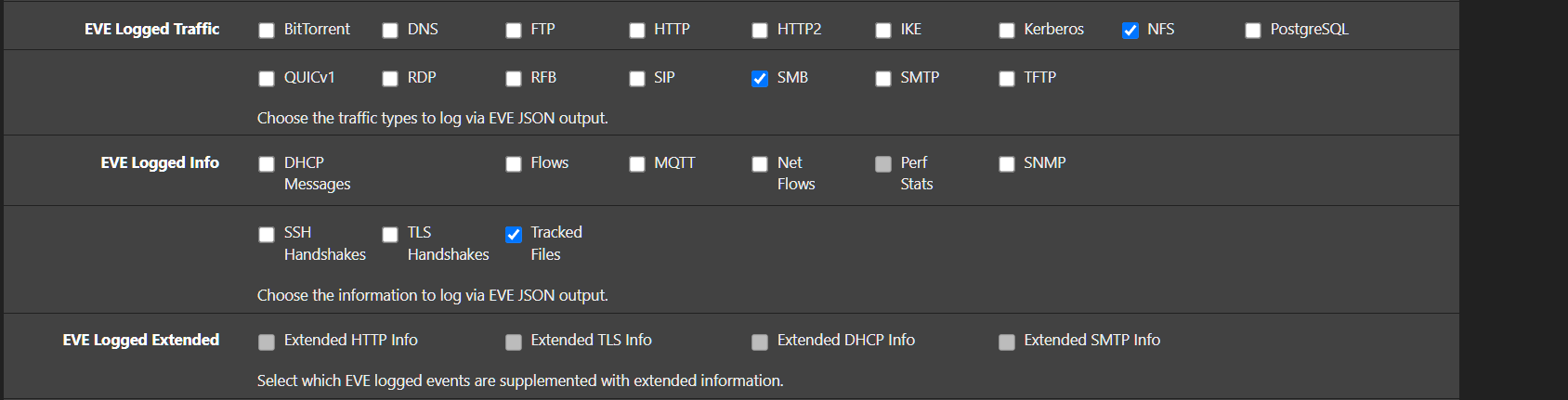
    Those are two independent things: File Store versus EVE JSON http logging. File Store captures all file transfers where appropriate flow bits are set by rules. EVE JSON logging is about capturing the packet metadata and payload (when enabled). So, turning off HTTP logging in the EVE JSON logging options should remove logging of HTTP packet metadata, but that will not stop File Store activity related to HTTP. To the best of my recollection that is triggered by the rules you have enabled for file capture and the corresponding flowbits they may set.
Copyright 2026 Rubicon Communications LLC (Netgate). All rights reserved.